Pages

Showing posts with label classroom ideas. Show all posts

Monday, 8 February 2016

Working on Vocab... naturally!


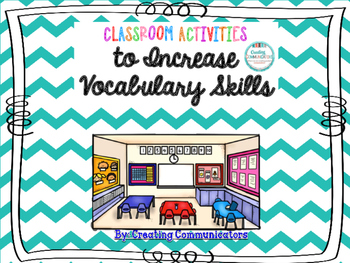
Many students (especially ones who are in low socioeconomic schools) are at risk for having low vocabulary skills and  I see many kids who need help targeting their vocabulary skills. Often times they need help naming items from a group, identifying group names, and naming the functions and attributes of items. I have told you before that not only do I do one on one therapy, but I also provide in-class activities. I recently made a pack that can be given to teachers so that they can target this skill while I am unavailable. I made the pack that can work for varying  abilities and the games are made to be more interactive and a natural way to get the vocabulary going.... Included are pictures for younger students and also written/verbal activities that do not include any prompts for students who are older. 
These activities are meant to be printed off and cut out for quick and low prep use. You don't even need to laminate if you don't want to!! (Even though I seem to love the laminator!!!)


Classroom Activities to Increase Vocabulary Skills 

You can also send this home with your students so that they can try these activities at home or for homework. It makes homework a little more fun and interactive!


Check it out and see if you like it! I would love to hear your feedback!

Monday, 30 November 2015

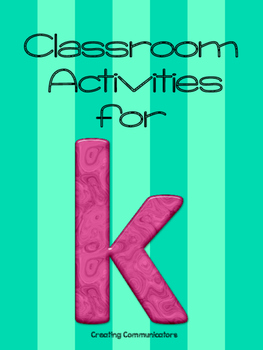
/k/ in the classroom

Many times I have had teachers ask me how to target a sound that many students in their class are not saying correctly and it got me thinking....
 K in the Classroom


A little bit of background- I live in northern Alberta and here services are provided through the health region or they contract private speech services. The health region provides services to schools (free the cost is covered by the Alberta Government) but there are so many schools and students that need services that some schools only receive a few months of service per year. This means that SLP time is at a premium and we need to start targeting some goals in the classroom. I know teachers are already busy and overworked so I wanted to make something easy for them to use, and print so it would be more likely that they would use it and their students would benefit from it. I wanted the pack to be clear and laid out step by step but also to have educational benefit. 


I came up with this idea that can be given to teachers and worked on in the classroom. Each activity is designed to need little prep and be carried out in just a few minutes.
I am planning on making a few more that target common errors like /s/, /sh/, ...? 


Do you have any ideas of a sound that you would like me to target? Comment below!


Sunday, 9 August 2015

iPad about me!


Back to school, it's time to get ready!


I hope you are enjoying your last little bit of summer but if you are starting to get ready for the school year I’ve made something that would be great on the first day of speech!


iPad about me is a cute little freebie that you can use to get to know your students as they start (or return) to speech therapy! They can color the frame to make it their own. You can put it on display or put it in their homework book! It’s available in my store or shop!


I hope you like it!
Cheers,
Mindy

Saturday, 16 November 2013

GIve a little bit.....

                                                                 Altruistic

Today my post has deep meaning for me.
When I am having a bad day, or feeling sorry for myself and unappreciated I put on that song by the Goo Goo Dolls & Supertamp-Give a Little Bit. I really love that coca cola commercial that features the song. I don't know why but it always makes me feel better. It makes me think of the word altruistic which means you do something for someone with out expectations. You just do it because it feels good without having any regard to how it can be of benefit to you. This is how I feel about speech and the kids. I like to see them and help them achieve their goals because their success makes me feel good and in return I don't want anything from them. I work hard at helping them and helping them achieve their goals through fun and engaging activities. (I hope!) If everyone did their job, passionately and to the best of their abilities, with out expectations wouldn't the world be such a great place!?
 Next time you go to work with the kids and you are having a bad day, or feel cranky, just take a few quiet minutes, and remember why you started this job. Think about the kids! Put a smile on your face and try to focus on the good! Then hum to yourself Give A Little Bit...

Here is the video for inspiration!


And with that being said- go out and do something nice for someone, unexpectedly, just because! You know a random act of kindness!
I bet it will make you just as happy as it makes them!
 
 
Cheers,
Mindy

Monday, 11 November 2013

Kindergarten Activity Centers- part 2 freebie!

Hi everyone!
Hope you all observed 2 minutes of silence in remembrance of our present and past veterans.

I am just letting you know that I have completed part 2 to my kindergarten activity centers! YAY!


I have created activities from January - May. Each activity has been created to be hands on & a fun learning experience for your class. The activities are designed to be modeled once for the class and then the students can work on the activities for more practice.

Some of the activities included are:
*present, past and future tense verbs
* beginning sounds
*segmenting words into their sounds
*wh questions
*associations
I have also included instructions for parents to practice the skills with their children to promote mastery- 1 activity for every month.


And I have it as a freebie in both my shop and my store! All I ask is that you follow my blog and my shop! So, please, check them out because they wont be free long!

Have an awesome speech week!

Cheers,
Mindy

Friday, 18 October 2013

Following Directions


HOW CAN I CREATE THE BEST ENVIRONMENT FOR MY CHILD TO FOLLOW DIRECTIONS

Some children have problems following directions even when they hear you talk and understand your words.  To help your child learn how to follow directions you can minimize distractions and it will help your child to focus on what you are saying.

Here are some ways you can create an environment that encourages your child to listen and learn:


1.    Get rid of distractions.  Noises, like the television, radio and other people talking, make it hard for your child to listen and follow directions.  Before you give your child a direction, turn off the noise or take the child somewhere quieter.


2.    Prepare your child to listen.  Let them know when it is time to listen. Encourage your child to look at you.  Call their name and say. “Time to listen.” You can also give your child a signal such as pointing to your ear.


3.    Pair actions with words when you give your child a direction.  The action makes it easier for your child to understand and follow directions.  Natural gestures will give your child added clues about what you want him to do.  For example, say, “Give it to me,” while reaching for the item with our hands.


4.    Speak clearly and slowly.  A slower than normal rate of speech and pauses between ideas will help your child understand what you want him to do.  Emphasize important parts of the direction by saying those words LOUDER and L O N G E R.

 
5.    Repeat instructions to help your child remember.  When you repeat- just repeat the key words or phrases. For example: teeth then book. If you use too many words over and over your child will tune you out and not follow any directions!

 
6.    Give one direction at a time or group directions that are similar.  For example, say, “Wash your face and brush your teeth ; then get your book and we’ll read it together” .
 
7.    Use examples, demonstrations or pictures.  When possible, use examples from your child’s background, interests or experiences.  These cues will make directions more meaningful to your child.
 
8.    Use words that your child knows and understands.  If you must use new words or concepts, use these words in a variety of ways to help your child understand their meaning. Use body and gestures to get your point across.
 
9.  Be positive.  When your child follows all or part of a direction, praise your child.  Provide positive feedback to help your child learn.

DOES YOUR CHILD KNOW THE VOCABULARY
FOR FOLLOWING DIRECTIONS?

Following directions can be tricky. You need to know a lot of words! Children might have trouble following directions because they don’t understand the words (vocabulary).  To follow directions successfully, our child must understand a lot of different concepts (concept vocabulary).

Does your child have the words and concept vocabulary to follow directions?  Ask yourself these questions:


Does my child know colors?
Examples:  red, grey, orange, pink. 

  • Could he follow this direction?  “Everybody get a red ball and stand in line”.

Does my child know shapes?
Examples:  circle, square, triangle, rectangle, oval, diamond. 

  •  Could he follow this direction?  “Draw a square on your worksheet”.

Does my child know size words?
Example:  big, tall, large, medium. 

  •   Could he follow this direction?  “Circle the dog with the short tail”.

Does my child know common school directions?
Examples:  cross out, underline, draw a circle around, and put a line through. 

  •  Could he follow this direction?  “Cross out all of the works that start with b”.

Does my child know quantity words?
Examples:  most, least, few, some, less than. 

  •   Could he follow this direction?  “If you have less than 5 mistakes on your worksheet, you can have free reading time.”


Does my child know spatial concepts?
Examples:  in, on, under, beside, behind, in front of, above, below, left, right, east, west. 

  •   Could he follow this direction?  “Write your name above the first question.”

Does my child know time concepts?
Examples:  today, yesterday, before, after, later. 

  •  Could he follow this direction?  “Before you go out for recess, hand in your math”.

Does my child know sequence words?
Examples:  first, second, last, next, beginning. 

  • Could he follow this direction?  “The second person in each row can hand out the workbooks.”

Does my child know opposites?
Examples:  hot/cold, skinny/fat, rough/smooth, wide/narrow, same/different.  

  •   Could he follow this direction?  “Be sure to use different colors on your picture.”

Does my child know emotion/feeling words?
Examples:  happy, afraid, tired, disappointed. 

  •   Could he follow this direction?  “Which character in the story was angry?”


The following activities are some suggestions of games to play with children. Please adapt them to meet the needs of your child/student.  Listening and comprehension monitoring skills can always be encouraged when reading poems and stories.

·         Barrier Games:  The listener and speaker have identical sets of objects (e.g. a girl doll, a boy doll, a red chair, a blue chair).  A cardboard barrier is placed so that the listener cannot see the speaker’s objects.  The speaker arranges his objects and then the partner has to match the items after being given a direction by the first player.


Barrier games can be created using any two sets of materials that can be manipulated, including:
Ø  Mr. Potato Head
Ø  Lego
Ø  Sticker boards


·         Crafts:  The speaker gives instructions (e.g. to make a paper snowflake).  The listener is guided to evaluate whether the instructions were adequate or request clarity.

·         Cooking:  A recipe is read out loud.  The child must request repetition or clarification, and ask the speaker to reduce the rate of speech or the number of items presented.  For example, the speaker may read the entire recipe rapidly without pausing.  The student is prompted to say, “Tell me them one at a time.”

  
·         Role Playing:  Act out the communicative exchanges. Example:

Ø  One person invites another to a party giving the date, time, and address.
Ø  Telephone messages.
Ø  A waiter takes orders in a restaurant and gives them to the chef.
Ø  Classroom situations.

  •  Play Simon Says