Here is my first AAC product for Core words: Included in this pack are ideas and activities for:
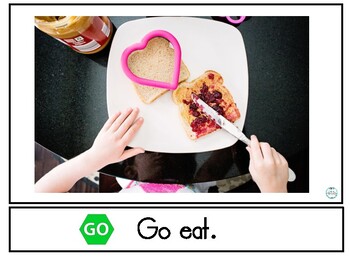
Go
Stop
Help
Put
This pack is for parents or teachers who have little to no experience using AAC. The core vocabulary is meant to start with straightforward, daily activities.
The first page is core board, and pages 4-7 are printable so that you can use them throughout the class and home.
Pages 8-11 are for colouring and playdoh mats.
You can make the other pages into a book and model the core words. You can also use them as ideas of how and when to model the core words during activities.
I work with aides who have little to no experience with using and implementing an AAC. I bought this product to help teach them. It is a great comprehensive resource that walks you through step by step.
In her words...
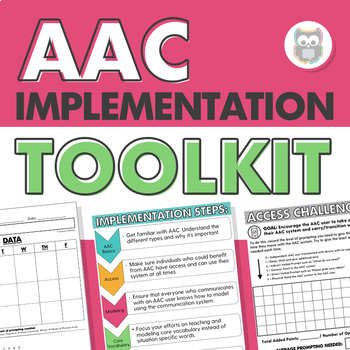
One of the most important parts of AAC implementation is making sure that the entire team (family members, staff) is consistently using simple but effective AAC strategies such as consistent AAC access, modeling, and core vocabulary. This resource will help you educate others about four foundational, research-based, strategies (or "best practices") for implementing and teaching AAC. This resource includes five sections as follows:
AAC Basics: Get familiar with AAC, what it is, the different types, and who uses it.
Access: Make sure the system is out and available at all times.
Modeling: Consistently model using the system.
Core Vocabulary: Focus on core vocabulary and keywords.
This resource is so comprehensive and helpful. I definitely encourage you to take a look if you have anyone on your caseload that uses an AAC. :)
Thank you, Speechy Musings for making such a wonderful product!!
I am working with a lot of students who are using an AAC. 2 years ago I didn't have one kid on my caseload and knew nothing about AAC's - I had to learn, and I had to learn quickly. And not only did I have to learn I had to learn how to teach others to implement it- no pressure :)
I found this excellent resource that supports me and the staff of the students I serve in a comprehensive step by step toolkit that hits on all of the critical areas!
1) AAC Basics
2) ACCESS
3) MODELING
4) CORE VOCABULARY
5) COMMUNICATION OPPORTUNITIES
This pack is filled with challenges, ideas on monthly core words, the list goes on. It is everything you need!
What is it? Masterpal is a program Tabi Jones-Wohleber has made to help communication partners that are using AAC's.
MASTERPAL is compromised of 11 modules in all (1 overview for administrative discussions and 10 for communication partners), and each one includes slides, handouts, discussion prompts, links to videos, and activity suggestions.
In my schools, I have to support teachers and aides to work on core vocabulary and do it easily. AAC is not easy for everyone, especially people without a speech background. Teachers, in my experience, have wanted to use it as sight words, and also said explicitly- "point to go." Nails on a chalkboard! UGH, natural is critical. Use it the same way as you would when you are speaking to babies- but I digress... Many educators need so much ongoing training and support... Masterpal can help you with all of this. If you want to "hear" about it you can listen to the Podcast on AAC- Talking with Tech MASTERPAL was developed from the premise that:
1) AAC implementation is not intuitive 2) communication is not compliance.
MASTERPAL focuses on the idea that- modelling language with AAC is our responsibility.
The training module topics include:
Overview of ‘Model as a MASTER PAL’ (to share with directors and other stakeholders to provide information about the importance of providing effective and ongoing support for communication partners of individuals who use AAC.)
There is so much to know with AAC use! And it's even harder to train others....where do you start? I needed a simple product that I could give aides on just the basics- like first use it and use it often. Throughout the day- in all ways, always!
I made a quick, very easy to implement and read product to help people who are lost (don't worry we've all been there!) My first advice is start- and use it just like you would speak (to a baby) only focusing on important words/concepts at a time with no expectation that the child will respond.
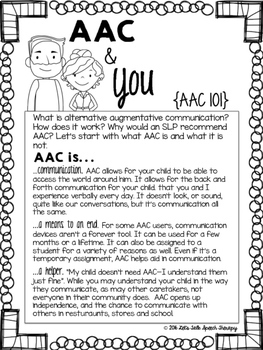
Hey Guys, and Gals! This is the first year that I have worked extensively with clients who are using AAC's. I had to jump right in, didn't know much! Now I have one child at every one of my 5 schools and a couple of private clients. I found some really great handouts for parents and teachers from Let's Talk Speech Therapy. She also has some freebies. If you have any kids who use AAC's on your caseload, I suggest you take a look. :)
Remember, I started talking about about AAC's a while ago (click on the icon below for that post) well, I wanted to elaborate on that post.
I have a few kids on my caseload that are using Alternate and Augmentative Communication Devices. Remember AAC doesn't always mean iPad, it can mean gestures or communication boards, etc. Some of those kids are beginners and some are already able to tell me short stories on their devices! YAY! There is so much to learn. I need some way to help me organize my thoughts, and help me differentiate between the different levels that the kids were at. I needed help!
I had heard there was this very cool resource called AAC Language Labs. So, I looked into it and was I ever surprised! It was all there, everything I needed and all organized. There were plans for SLP's, educators and parents. Everything was organized into different stages and materials, and games that you could use to teach new skills. I am in love! My life was made a whole lot easier!! SO HAPPY!!! On AAC Langauge Labs its all the there, laid out and easy to use. Complete with activities, lesson plans, materials and videos for SLP's, parents and educators. Everything is right here. LOVE AT FIRST SIGHT! ♡♡ For SLP's there are: Language Stages and Goals
The “Stages” that form the foundation of the AAC Language Lab are information gathered from different resources, and organized in a single chart of teachable
segments, called Stages. Because the acquisition of new language skills
flows gradually from stage to stage, it is not unusual to find skill
development overlapping the stage divisions. Therefore, the stages
provide a general structure, but should not be interpreted rigidly.
Clinical Lesson Plans
Clinical lesson plans are based on specific expressive and receptive
language objectives. They are designed to guide your student through
developmental milestones as they improve their functional and academic
communication skills using their preferred expressive method (ie. verbal
speech, voice output communication device, etc.). Lesson plans are
organized and grouped by language stage. Each lesson plan contains:
a target language outcome
a short list of vocabulary words
suggested objectives
ideas for teaching activities
links to Smart Charts with Unity icons
Common Core Standards by grade level
Mobile Lesson Plans
Mobile lesson plans are designed for a variety of language levels
using popular education apps. The focus of each lesson plan is to show
different ways the apps can be used to help a student become a better
communicator. Lesson plans are divided according to skill level and
activities can be adjusted to address the needs of each student. Common
Core Standards by grade level are referenced in each lesson plan.
Mobile Lesson Plans are organized by language stage; Beginner, Intermediate or Advanced.
If you have anyone on your caseload that is using an AAC, I highly suggest you taking a look. It will definitely help you, the child, their teacher and family on their journey! Plus it is very reasonably priced- starting at $19.95/YEAR! Don't forget to check out their free resource page! Don't forget to check out my shop!
Leave me a comment, if you've used this services and let me know what you think!
Last week I took an online course-Model, Motivate, Move Out of the Way. I loved it! Such great information.
I have a few kids who are using AAC's and I don't have much experience so I went looking for some information. I found a course through ERLC (in Alberta) and signed up for MMM. It was so informative. During the 1 hour, free, course I learned so much. Kate Ahern did the presentation and she has placed her powerpoint. I think anyone in the speech world should read it, all teachers and all parents.
I made a quick list of information I found important:
AAC is any kind of non-verbal communication including gestures, sign language, spelling, communication boards and technological devices (like iPads.)
Always presume that the student has not yet learned a way to communicate and not that they "can't do it." They need us to teach them how to communicate their needs/wants and feelings.
Communication Bill of Rights, every person has the right to communicate their need, wants and feelings.
Every person has the right to be treated with dignity and respect. To be spoken to and not about and to be taught how to communicate.
When you are working with an AAC- start small.
Don't use the device for asking "find the... or where is the..." Use it to communicate not as a receptive tool.
You need to use it, model it, model, model! The student won't learn how to use it unless you use it and model how to use it.
Use it in a motivating way so that it is fun. If its no fun, and not useful, the student won't be motivated to use it.
Always have the device handy. Don't put it away, keep it accessible at all times.
These are just a few of the important points, and I am not doing this pp any justice. Kate is a wonderful speaker, if you have the opportunity, listen to her. If not, definitely check out her blog and read her pp. There is some wonderful information that is useful for everyone!!
Thank you for all the wonderful, useful information, Kate!
The Triple P – Positive Parenting Program is an internationally-recognized program that gives parents the skills they
need to build strong family relationships, manage misbehavior and prevent problems happening in the first place.