Pages

Friday, 2 June 2017

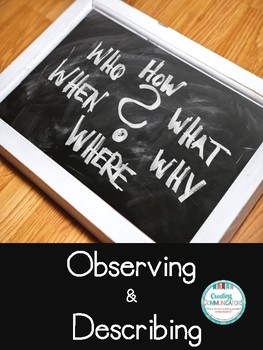
Observing and Describing

I have so many students that are older and I am feeling that their language goals (like plurals) just aren't cutting it.  I decided I wanted to create something that would help them target some FUNCTIONAL CLASSROOM GOALS!


Observing & Describing


According to Reading Rockets: "Inference. Observations occur when we can see something happening. In contrast, inferences are what we figure out based on an experience. Helping students understand when information is implied, or not directly stated, will improve their skill in drawing conclusions and making inferences."

This observing & describing product is a great way for students grade 4 and up to practice important skills in reading, observing, comprehending and making inferences. Observing, describing and making inferences are important skills for all readers. This product teaches this skill in 5 steps: choose words that describe the picture, generate your own describing words, generating descriptive words that are relevant to the picture to make the sentence more descriptive, then describe who, what, where, when and eventually why based on pictures, and then making inferences about pictures. Step 1- choose from a series of words to best describe the picture.


Step 2- generate their own describing words based on the picture. Step 3- add adjectives and other describing words to make the sentence (already provided) more interesting and descriptive.


  Step 4- describe the pictures using what, where and when, then eventually why. Then they can use their words to create a descriptive sentence that describes the picture. Step 5- making inferences about pictures. Explaining what happened or will happen based on information from the picture.


What do you use with your students??

 
If you have any questions email mindy@creatingcommunicators.net.


** To save on ink don't print the first page :)

Wednesday, 31 May 2017

Match It!!


If you are anything like me, by May you are in need of some new stuff for your little guys. They get tired of the same old stuff... quick. :) So I started making something...
Here is my relatively new Associations Mats- Match It Pack.

Use these mats as a fun way to improve vocabulary in the classroom as a center or as a simple, and fun activity in Speech Therapy!
Print, Laminate and cut only cut apart pages 3 and 9 leave the other pages as mats! If you have time (and energy!) you can use velcro too!  Match It!
Use the mats for a center activity and put all of the pieces (pages 3 & 9) in the middle of the table. 
Have the students choose the correct pieces for their mats and explain why they go together.


**There is 1 picture that includes a Canadian twenty dollar bill, Canadian quarter and penny. Although they are the Canadian version, they are still applicable for Americans as the bill is green. :)
I also want to use these mats with little manipulatives - like little toys from the $ store. They would be so good for pre-k kids- engaging and hands on!! Thesis will love it. And if you want to talk RTI - it would be a good center to give to your pre-k or kindergarten room(s). I'm still working on those mats but keep an eye out cause I will get them added soon...

Chat soon,
 

Mindy

Thursday, 25 May 2017

FREEBIE!!


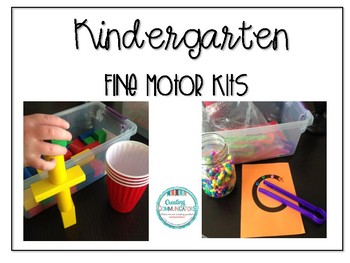
Don't forget about my Kindergarten Fine Motor Kit freebie~


Kindergarten Fine Motor Kits


These kits are so easy to assemble and use. You can use them in speech therapy too! Incorporate speech and OT in one session, the kill 2 birds idea. Many of our kids need to work on their OT skills for printing, writing and all of those other fun skills they need for school. You can use this kit for OT while targeting following directions, literacy  and awareness of letters, concepts, patterns and vocabulary. It targets so many goals all in one!!

 Kindergarten 
Fine Motor Kits
That target pincer grasp, strength, bilateral coordination, and object manipulation.
Credit: Chantelle Robertson, Occupational Therapist.

Fine Motor Kit 1- Pincer Grasp
Kit- Letter outlines and beads
Objective- improve pincer grasp and learn letter formation.
Task: have students place beads along the outline of the letter starting at the tip of the letter (to reinforce proper letter formation). The student will use their thumb and index finger (prince grasp) to pick up the beads and place them on the line. Having a strong pincer grasp is important in promoting the tripod grasp, its also important in self-care tasks (zippers and tying shoes).


 Fine Motor Kit 2- Strength
Kit-Playdoh and small toys and other manipulatives
Objective: improve hand strength
Task: have students dig in the playdoh with their hands and pull all of the playdoh of each toy. Hand strength is important when completing classroom skills like using scissors and also when completing daily tasks like opening jars. When the student finds an item, have them talk about the item. For example where the item is found, what it does, what group it belongs to, its parts and what goes with the item. You can also use concepts like place the car on the bin, in the bin, behind the bin, etc. 


Fine Motor Kit 3- Bilateral coordination/ 2 hands
Kit-pipe cleaners and beads
Objective: improve bilateral coordination and numeracy

Task: have students a number and identify it. String the same amount of beads onto the pipe cleaner. 
Ex number 2 pipe cleaner: string 2 beads.
Using 2 hands together is important during printing and cutting tasks and two hands need to work together. One hand holds the paper and the other the tool.


Fine Motor Kit 4- Object Manipulation
Kit-blocks and cups
Objective: introduce sorting, patterns, object manipulation, turn taking and cooperative play skills.
Task: have students sort blocks by color into cups. Once each student has several blocks in their cup they can take turns adding to a tower. They can work in groups of two to create ABAB patterns in their block towers. Have the student count how high their tower is. Object manipulation is important when completing puzzles and craft projects. Cooperative play is a developing skill in 4 and 5 year olds which some student may find difficult.

Thursday, 18 May 2017

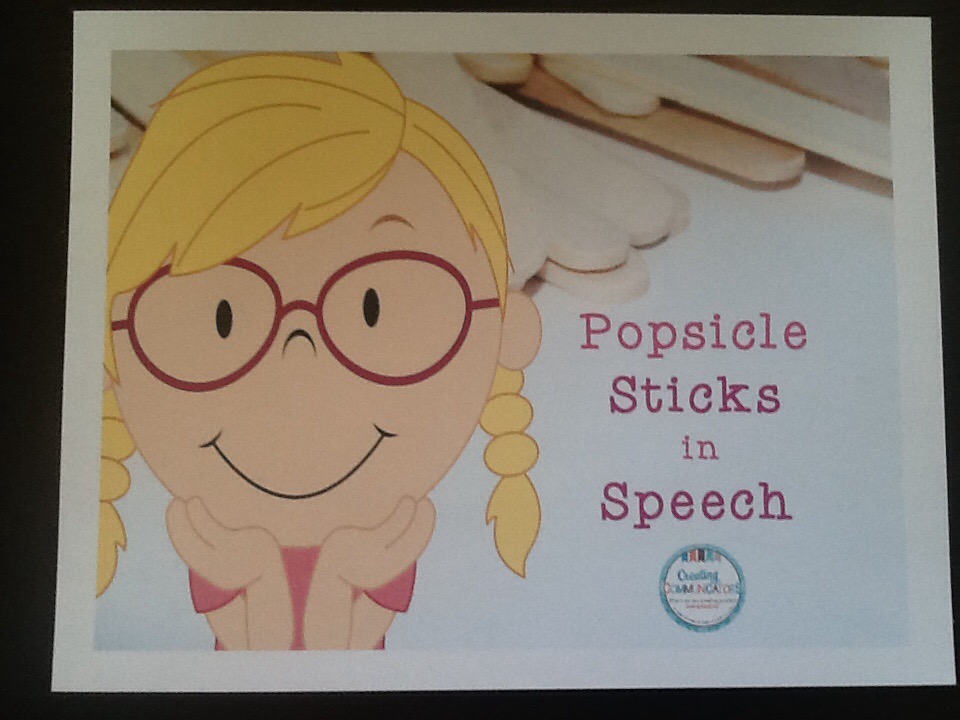
Popsicles in Speech Therapy

https://www.teacherspayteachers.com/Product/Popsicle-Sticks-in-Speech-3163102 


 https://www.teacherspayteachers.com/Product/Popsicle-Sticks-in-Speech-3163102 

I've been working on this latest project for a while...I was (am) getting tired  and burnt out, who isn't?? (I know, right??!!)
When that happens (usually in May) I also get tired of my resources and I wanted to try something fun that I could use in speech but also give to teachers that would be helpful with RtI. I am just starting to get the hang of RtI and since no one around me uses it, I am taking the bull by the horns and introducing it in my schools. But enough about that because I am still learning :) 

The creating this popsicle pack because I needed a fun and unique way to target common goals. This pack can be used in speech therapy or as a center in your class. This pack targets:
Concepts
Categories


Now get ready because you are going to be cutting and laminating, but it will be worth it to have a resource that you can use with almost your entire pre-k caseload! Some resources are even good for older kids up Grade 3 (depending on their skills).


https://www.teacherspayteachers.com/Product/Popsicle-Sticks-in-Speech-3163102 
 The rest of the pack includes opposites, possessives, beginning sounds, diagraphs, syllables and segmenting words! WOW = there is A LOT!


 I used these big popsicle sticks but this will also fit on small popsicle sticks- the big ones are easier to work with. :) I bought them at Wal-Mart but I am sure you can find them at any $ Store.


Let me know how your school uses RtI? Leave your comments below!


Cheers,
Mindy


Monday, 15 May 2017

This Goes With That?

Hey Everyone!

I haven't talked to you in a while, I hope your May is buzzing along!

By the end of the school year I am tired of my resources so I go on the search for something new. I recently purchased this from Really Good Stuff. It's called This goes with that. It's a new way of targeting vocabulary (associations) and it works well with older kids.
It gives the kids an opportunity to write and draw how items go together.


This is a good activity for a center or groups to work on while you are providing some one on one. This activity provides 1main picture and then a choice of 3 at the bottom. The student picks a colored circle (they come the game and they are made of cardboard) and they match it the item that's associated and explain why they are related.

Love it!! Easy Peasy!!
Check out Really Good Stuff- and it's cheap!!!

Sunday, 9 April 2017

Speech Language Assessment for Students with Autism


I am going to be really honest here... I have some kids on my caseload that are on the Autism Spectrum and I felt like I wasn't really doing much for them, especially the kids who were non-verbal (or pretty close). I had assessments and goals and I really felt like I wasn't making much of a difference and the progress seemed to be limited (if at all). It was starting to bother me... These kids are the ones who need the most support and most involved services and I just didn't feel like I was making the cut.

 I went looking around and found some great information. I found a great video on an assessment tool that is created for students with autism. Not only does this tool assessment assess their language but it also provides ideas on the barriers that might be hindering their progress! 
What!? Great information!!
You can also purchase the testing material for under $70 and there is an app that is even cheaper. At that price it is definitely something to loo


I am really interested in trying it out...
Take a look! 
 https://www.teacherspayteachers.com/Product/Autism-Assessment-Example-Verbal-Behavior-Milestones-Assessment-VB-MAPP-3085121


"The VB-MAPP is an assessment and curriculum guide by Mark Sundberg, PhD, BCBA that is based on 170 developmental milestones and research from the field of Applied Behavior Analysis. It has been field-tested with children with autism, children with other developmental disabilities, and typically developing children.

It provides a clear and accurate picture of an individual child's abilities. 

The overall program contains:


  • Skills Assessment – Assesses 170 language and social milestones across three developmental levels
  • Barriers Assessment – Assesses 24 language and learning barriers and can be used for planning interventions and tracking progress
  • Skills Task Analysis and Tracking System – Contains over 1,000 skills that support the milestones, and can be used to record and track progress
  • Transition Assessment – Identifies the skills needed for successful transition to less restrictive learning environments
  • Placement and IEP Guide – Suggests direction for the intervention program based on the child's profiled strengths and weaknesses


  https://www.vbmappapp.com/


The information contained in this blog is meant to be used as a helpful resource for Speech Language Pathologists looking for treatment or assessment ideas to support their therapy. This is a personal blog. The opinions expressed here represent my own and not those of my employers, The information written here is meant to support speech language pathologists. It is not meant to replace consultation or treatment provided by a certified Speech Language Pathologist. If you are a parent, caregiver, or teacher who is concerned about the speech & language development of a particular child, you are encouraged to seek out a complete evaluation from a Registered SLP. All therapy materials, websites, or applications mentioned in this blog are discussed as potential tools to aide in the development of speech and language skills. These tools are to be used as a part of, or in adjunct to, speech language therapy services and not in place of those services. It is up to the individual professional to determine if any of the mentioned therapy tools are applicable to the therapy process for each individual child. In other words, all content of this blog should be read and used at the discretion of the reader.

Copyright Information:Feel free to use any of my images or ideas as long as you give Creating Communicators credit and link back to me. Thanks! PLEASE do not sell my ideas as your own.

Friday, 7 April 2017

SLP Must Have


My SLP Must Have  Product for April is My Easter Pack!
Enjoy!