Pages

Showing posts with label fluency. Show all posts

Monday, 4 June 2018

Fluency Strategies

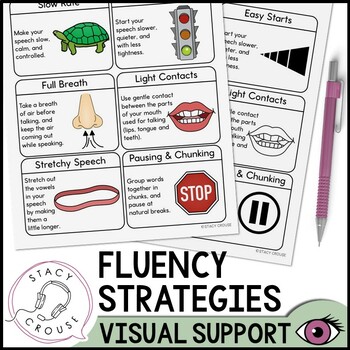
Fluency Strategies Visual Support 


I have an older student who is working on fluency.
Keep in mind, younger kids commonly go through a period of having disfluent speech. 
 "Normal disfluency is stuttering that begins during a child's intensive language-learning years and resolves on its own sometime before puberty. It is considered a normal phase of language development. About 75 out of 100 children who stutter get better without treatment."


According to ASHA:

Characteristics of Typical Disfluency and Stuttering

Differentiating typical disfluencies and stuttering is a critical piece of assessment, particularly for preschool children. Without proper intervention, children who exhibit signs of early stuttering are more at risk for continued stuttering. The chart below describes some characteristics of "typical disfluency" and "stuttering" (Adapted from Coleman, 2013).
Typical DisfluencyStuttering
Speech Characteristics
  • Multisyllabic whole-word and phrase repetitions
  • Interjections
  • Revisions
Speech Characteristics
  • Sound or syllable repetitions
  • Prolongations
  • Blocks
Other Behaviors
  • No physical tension or struggle
  • No secondary behaviors 
  • No negative reaction or frustration
  • No family history of stuttering
Other Behaviors
  • Associated physical tension or struggle
  • Secondary behaviors (e.g., eye blinks, facial grimacing, changes in pitch or loudness)
  • Negative reaction or frustration
  • Avoidance behaviors (e.g., reduced verbal output or word/situational avoidances)
  • Family history of stuttering


I really wanted something simple and clear to give her to remind her to have smoothe speech. I went looking and found this.
I really like these visual strategies for fluency.
Easy to print, easy to use and really great for my older students. We can post them in the speech room, or they can take a copy and post where they would like them.
They are only a $1, and all of the strategies are very useful!
Thanks!





Saturday, 2 January 2016

Fluency vs. Dysfluency

Fluency vs. Dysfluency

 
Recently I had a parent ask me about her son, she was concerned that he may be stuttering. Another term for stuttering is dysfluency. I thought maybe I should throw some information out there because I am sure there are other parents who are wondering when it is normal and when it is a problem.


*Normal Dysfluencies occur most often between ages one and one-half and five years, and they tend to come and go. They are usually signs that a child is learning to use language in new ways. If dysfluencies disappear for several weeks, then return, the child may just be going through another stage of learning.


When is dysfluency normal?


*It is normal for a child to occasionally repeats syllables or words once or twice, li-li-like this. Dysfluencies may also include the use of fillers such as "uh", "er", "um". 


*Dysfluency is most common between 3 and 5 years, when language development is particularly rapid.


When should I be concerned?
*When there is avoidance to speak and child is aware that speaking is difficult.
*If there is tension when speaking.
*If there are secondary characteristics like body and facial tension, eye blinking or closing, or other physical characteristics. 


I found these videos  and thought they would be particularly helpful and informative for parents.

Here are some more websites with valuable information:


Cheers,
Mindy